What counts as warehouse handrail guarding?
Warehouse handrail guarding is the physical barrier layer between people on foot and everything on your floor that moves under power. It is the family of fixed industrial barriers, posts and rails that keeps traffic, structure and pedestrians apart.
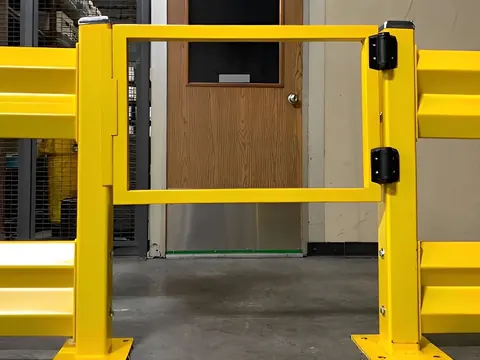
The same hardware does two different jobs. At an elevated edge it is fall protection. At floor level it is impact protection, and the two get specified differently even when they look alike.
The common forms on a warehouse floor:
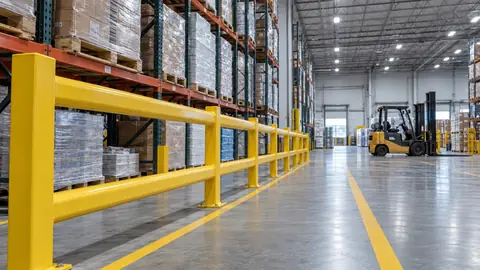
- Perimeter guard rail along walkways and open floor edges
- Rack-end guard at aisle entries
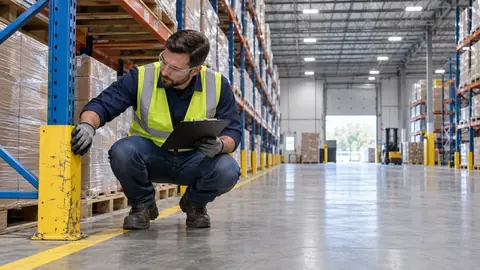
- Column and equipment protection
- Handrail at stairs and mezzanine edges
Why guarding gets specified after an incident instead of before one
Warehouse safety spend usually follows something. A near miss, an insurer walkthrough, or an audit finding moves guarding off the wish list and onto a purchase order.
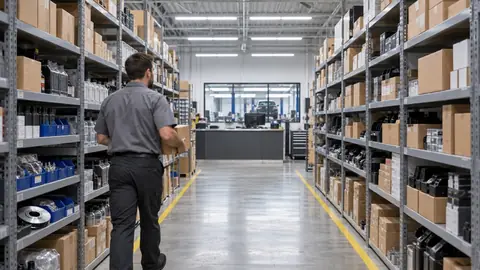
The exposure is older than the incident. It lives wherever forklift routes and pedestrian routes overlap, which is almost always a dock, a doorway, or a pinch point between two racking runs.
Impact energy is the design driver. A lift truck carrying a load at aisle speed puts far more into a barrier than the same truck empty. That difference is what protection gets chosen against.
So the useful question is not which catalog tier to buy. It is what traffic actually runs in your facility, on which routes, at what speed and with what load. Answer that first, then specify.
Questions plant engineers ask when they scope a guarding project
Where should guard rail go first in a mixed traffic aisle?
Priority follows consequence. People first, then anything whose failure stops production, then property. In practice the first three are pedestrian walkways, dock edges and doorways, and electrical or utility equipment sitting in a traffic path. The method is a walkthrough. Guard rails get placed against observed traffic, not against a floor plan drawn before the racking moved.
Steel guardrails or polymer sleeved barriers: how do you choose?
Steel absorbs a hit and transmits the energy into the anchor. Sleeved systems are designed to deform and stay visible afterward. Your decision inputs are traffic speed, slab condition, wash-down or corrosion exposure, and how your site wants to handle repairs. Impact ratings come from the manufacturer's current published data, so we pull them with a spec request.
How do rack guards differ from perimeter guard rail systems?
Rack protection defends the upright and its load path. Perimeter rail systems define a boundary. They are not interchangeable. A rack guard that takes a hit protects a column, but it does not create the walkway edge that keeps people out of the aisle. Any real impact also triggers a rack repair decision, and that one belongs with the rack engineer.
Do bollards replace guardrails or work alongside them?
Bollards are point protection. Guardrails are line protection. Most floors need both. The practical rule is short: protect a point asset with a post, protect a route with a run. Safety barriers at a dock usually combine the two, because the exposure changes within a few feet of the door.
What does the install actually involve on an occupied floor?
Anchoring method drives the disruption, and the slab gets assessed before anything is committed. Sequencing the install by zone keeps the operation running while guards go in. Field measurement before the order is the step people skip. It is also the one they pay for twice when a run arrives short.
When to talk to a guarding specialist before you buy
Four conditions are worth a call:
- An audit finding or an insurer request
- A layout change or new equipment on the floor
- Any impact that damaged structure
- A walkway that has no defined edge at all
A site review adds what ordering products from a page cannot. You get measured runs, an anchor and slab review, and a phased plan that matches how the facility actually runs.
One thing is worth stating plainly. Current OSHA guardrail requirements are read at the regulator and confirmed with your own EHS officer. A supplier scopes the systems around that requirement rather than interpreting it for you.
Scoping a guarding project? Book a consultation for a site review.
FAQs on warehouse guarding and railing
Q: Does guarding by itself make a site compliant?
A: No. Guarding is one control among several, and the current requirement is defined by the regulator rather than by a product. Read it there, then confirm it with your EHS officer.
Q: What happens to a guard after it takes a hit?
A: It gets inspected. Anything deformed at the post or the anchor gets replaced rather than straightened. Log the impact as well, so the pattern gets addressed and not only the damage.
Q: Can guarding be added to an existing mezzanine?
A: Usually yes. The constraint is the structure and the edge condition rather than the rail itself, so field measurement and a structural review come first.
Walk your aisles before Q4 volume arrives
Traffic density climbs before the volume does, which makes October the honest month to walk your aisles and mark what needs to be protected. Book a consultation to request a site review or a quote.