Do Northeast Warehouses Really Have Seismic Racking Requirements?
Seismic racking requirements surprise people in the Northeast, because the region does not feel like earthquake country and the building code does not care how it feels. The requirement comes from the code your municipality has adopted and from the seismic design category assigned to your site. It does not come from whether anyone remembers feeling a tremor.
The practical consequence is straightforward. Above certain conditions, a racking system stops being equipment and becomes a permitted structure. That means engineered drawings, a stamp and a review before anything takes load.
The rest of this post covers what a seismic design category means and what changes inside the rack. Then who signs for it, and what the seismic permit process looks like. Compliance here is a sequence, not a product feature.
Why the Code Treats Racking as a Structure
A loaded pallet rack is a tall, lightly built frame carrying many times its own weight high above the floor. Seismic forces arrive at the slab. Move it sideways and the top level moves far more.
The code treats storage racks as structures rather than as furniture. Anchoring, bracing and connection design are part of the seismic requirement, not accessories you bolt on afterward.
Here is the part Northeast readers do not expect. Seismic design categories are assigned from mapped ground motion and from the soil under the site. Two buildings a few miles apart can sit in different seismic areas. People ask which seismic zone they are in, and the code assigns a category per site instead.
Occupancy matters too. Racks in a space the public walks into are treated differently from racks in a closed distribution center. The structural question is the same. The safety consequences are not.
Seismic events are rare here, and the requirement is not conditional on frequency. Buildings get designed for earthquakes they may not see in a service life. Earthquakes are a loading case, not a marketing hook.
Planning a rack system in a building nobody has assessed for seismic forces? Book a consultation.
Questions Plant Engineers Ask About Seismic Rack Design
What is a seismic design category, and who assigns it?
A seismic design category is a classification the code assigns to a specific site. It comes out of mapped ground motion, the soil under the building, and how the building is used.
The important word is site. The category belongs to the address, not to your company and not to the rack systems in it. A second facility in the same state, in areas that look identical, can land somewhere different.
You do not set it. What the design has to meet falls out of the geotechnical and structural information for the building, confirmed with your authority having jurisdiction.
What actually changes in a rack designed for seismic loads?
Compared with a rack designed for gravity alone, a seismic rack usually differs like this:
- heavier column sections
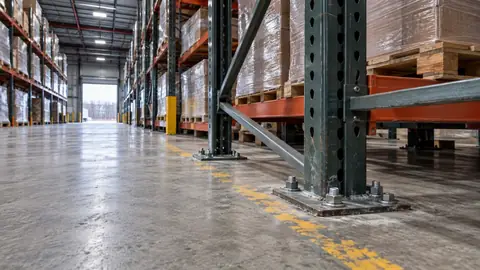
- larger base plates
- more anchors, and larger ones
- additional bracing
- stronger beam to column connections
- sometimes a lower allowable load per level
The trade is worth stating early. The same footprint of pallet racking may hold less, or need more steel, or both. It belongs in the budget before the layout gets approved.
Anchors interact with the slab, so slab thickness and condition become seismic design inputs rather than afterthoughts. Those differences are what compliance costs in steel.
Who has to design and stamp the system?
The seismic rack design comes from the manufacturer's engineering group, working to industry storage rack design standards. The submittal typically carries the seal of an engineer licensed in the state where the building sits.
Practically, that changes what you are buying. You are not picking bays from a catalog. You are commissioning a designed structure. What those standards require the system to meet is the engineer's to interpret, not a supplier's.
Does the permit process differ from an ordinary rack install?
A seismic permit application goes in supported by stamped drawings and calculations. The building department reviews it. A safety inspection follows, often including the anchors before load goes on.
Fire protection review frequently runs alongside. Rack configuration affects sprinkler design, and a comment there can change a settled layout.
Compliance specifics belong to your own building department, including whether a permit is required at all.
Does used or relocated racking carry its seismic rating with it?
A seismic rating belongs to a configuration at a site. Move the same steel to a different building, slab or height, and the analysis changes.
Mixed-manufacturer components are the specific trap. Connection capacity depends on matched components, and a run built from two sources is not the run either manufacturer engineered.
For used pallet racks the first question is whether the original design documentation still exists. What an engineer can certify without it is a conversation to have early.
What about cantilever racking, mezzanines and rack-supported structures?
The same seismic logic applies, and it generally applies harder. These systems are taller, heavier or occupied.
Rack-supported buildings, where the racking carries the roof and walls, are a structure in the fullest sense, engineered as one. Mezzanines add occupancy and egress questions on top of the structural ones.
Outdoor rack systems bring wind and environmental exposure into the same conversation, which changes the design inputs again.
What happens if racking already installed was never designed for it?
It usually surfaces at an inconvenient moment. A permit application for an expansion, an insurance survey, a safety audit, or a fire protection review.
The path forward is a seismic engineering assessment of what is standing. It may find the system adequate, call for additional anchoring or bracing, or call for derating.
Derating existing racks is a real possible outcome, and much cheaper to know about before the next expansion than during it.
When to Bring In an Engineer Rather Than a Catalog
Seismic racking requirements are cheapest to handle before the order. A new rack install that needs a permit. An expansion of existing rack systems. Adding a level or changing beam heights. A change in what you store. Moving racks between buildings. Or a rack safety, insurance or fire protection review that raised the question.
Have this ready: building address and occupancy, plus slab information if you have it. Add existing rack drawings and manufacturer, current configuration and beam levels, load per level, and your building department contact.
W.T. Hight Company does consultative material handling design across Massachusetts, New England and the wider Northeast. Seismic compliance belongs in the design conversation, not as a surprise at inspection.
Book a consultation to start that conversation.
FAQs About Seismic Racking Compliance
Q: What does an engineer need from you before a seismic rack review can start?
A: Have these ready:
- building address and occupancy
- slab thickness and condition, if known
- existing rack drawings and the manufacturer
- current configuration, beam levels and load per level
- what is stored and how it is handled
The more of this that exists on paper, the faster a seismic review moves.
Q: Does adding one beam level to existing racking trigger a new review?
A: Often yes, because it changes height, mass and load distribution. Those are exactly the inputs the seismic design had to meet. Whether it triggers a permit is your building department's call, so ask before ordering beams.
Q: Once the system is installed and signed off, whose responsibility is it?
A: The owner's, on an ongoing basis. Seismic sign-off covers the system as designed and installed. Damaged uprights, missing anchors, changed loads and unauthorized modifications move it away from what was approved. Regular rack safety inspection is how you catch that.
Settle the Engineering Before the Steel Arrives
Seismic design changes the equipment, the budget and the schedule. Finding that out after the order is placed is the expensive version.
Settle the seismic racking requirements while the layout is still on paper. Book a consultation to start that conversation.