Choosing the Right Conveyor for a Growing Operation
Conveyor system selection starts with a question most operations skip, which is not which conveyor to buy but which specific moves in your process are worth taking off people's hands first. Answer that one, and the equipment question largely answers itself.
The short version: map the product, the distance, the elevation change, and the throughput on the moves that hurt, then pick the least complex conveyor that covers them. Conveyor system selection is a process question before it is an equipment question. Operations that reverse the order end up owning a line built for volume they do not run.
Why Operations Outgrow Manual Movement Before They Notice
Growth rarely announces itself as a breaking point. It shows up as touches. The carton that used to get handled twice now gets handled four times, and headcount quietly absorbs the difference until it cannot.
The symptoms are recognizable from the floor. Staging piles build at the end of an aisle because there is nowhere else to put them. Staff walk loaded carts across the building because nobody wants to reslot. The pack line sits idle waiting on replenishment that is still moving by hand.
Material movement automation is a spectrum, not an all or nothing purchase, and that is worth saying plainly. Most growing operations do not need a fully automated line. They need the two or three moves that eat the most labor taken off the floor. Navigating material handling should not be daunting, and the answer is tailored to your facility rather than pulled from a catalog. That is where conveyor system selection begins.
What Operations Managers Weigh During Conveyor System Selection
The Main Warehouse Conveyor Types
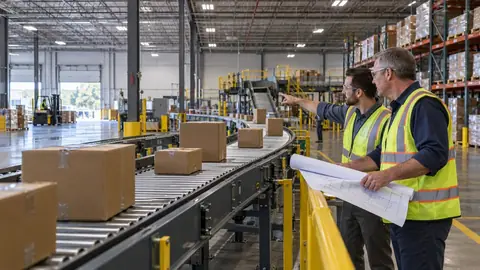
The warehouse conveyor types worth knowing fall into four families. Gravity roller and skatewheel move product on pitch with no drive, which keeps them simple and quiet. Powered belt carries irregular, soft sided, and small items, and handles incline well. Powered roller moves cartons and totes with more control and easier zone maintenance. Accumulation lets product queue without back pressure, which matters wherever a downstream station works at an uneven pace. Each family is good at something specific rather than best overall.
Gravity vs Powered Conveyor for a Growing Operation
The gravity vs powered conveyor decision comes down to run length, elevation, and predictability. Gravity wins where the product is uniform, the run is short, and the floor gives you a workable pitch. There is less to fail and no power drop to run. Powered wins where the run is long, the elevation change works against you, throughput has to be predictable, or the product mix is inconsistent enough that gravity behaves differently case to case. Most facilities end up with both, gravity where it works and powered where it has to be.
How Much of the Process to Convey
Draw the boundary tighter than instinct suggests. The productive scope is usually receiving to staging, or pick to pack, rather than the whole building. Map your moves by frequency and by distance, multiply the two, and convey the highest products first. That list is short, and it is where the labor actually goes. Designing for throughput the operation does not have yet is the most expensive mistake in conveyor system selection, so leave room to extend instead of building the future line today.
What the Building Itself Limits
The building constrains the layout before the equipment does. Column spacing, clear height, floor flatness, dock positions, fire protection layout, and where power can realistically be brought all shape the path. Aisle crossings and pedestrian routes decide whether the line needs a gate, a lift section, or an elevated run. When the real constraint turns out to be floor space rather than movement, industrial mezzanines are usually the better answer than a longer conveyor. Confirm clearance and fire protection requirements with your authority having jurisdiction.
How the Product Mix Changes the Answer
Product mix narrows the field faster than anything else in conveyor system selection. Carton size range, weight range, whether you handle bags and totes, and whether items arrive palletized will eliminate whole families before layout is even discussed. Irregular and soft sided items behave differently on roller than on belt, and the difference is not subtle. Bring the real extremes of your mix to the conversation, the smallest and the most awkward, not the average case.
What to Plan Now and What to Defer
Plan the path, the power, and the structural provisions now, because those are the expensive things to retrofit. Defer accumulation zones, sortation, and controls until volume justifies them. That split keeps a first phase affordable: stub the conduit, size the structure, reserve the floor space, then add zones when the volume is real. Good conveyor system selection leaves the next phase possible without making you pay for it today.
Talk to Us About the Layout Before Anyone Quotes Equipment
Have the layout conversation before anyone quotes equipment. Conveyor system selection works best in close collaboration, where the solution is matched to your requirements instead of assembled from a catalog page. Start with your building and your process, not a model number.
Have this ready: a floor plan, the extremes of your product mix, current and expected volume, the moves that hurt most, and the building constraints you already know about. Conveyors are one of the product lines we work in and mezzanines are another, so the recommendation is not forced toward either one.
Book a consultation. We work with facilities across the Northeast US and New England from Pembroke, Massachusetts, and this is a planning conversation, not a rush order.
FAQs About Conveyor System Selection
Q: Can a conveyor be added to an existing warehouse without shutting down?
A: Usually yes, with phasing. Installation is normally staged section by section around production hours or across a weekend, with the tie in points planned in advance. Raise the constraint early, because a phased install shapes the layout and the sequence, not just the schedule.
Q: Can gravity and powered sections run in the same system?
A: Yes, and combined systems are common. Gravity handles the short, pitched, uniform runs. Powered handles the long runs, the inclines, and anywhere throughput has to stay predictable. The transitions between the two are a design detail worth reviewing carefully.
Q: Does a conveyor have to be permanent?
A: No. Many sections are modular and can be reconfigured, extended, or relocated as the process changes. Portable and flexible sections cover seasonal or temporary moves, often the right first step while volume is still proving out.
Start With the Move That Costs the Most
Conveyor system selection comes down to finding the moves that cost the most in labor, taking those off the floor first, and leaving the rest possible later. Request a layout conversation, and we will start with your floor plan and your process. Book a consultation.