What Is Cantilever Racking Actually For?
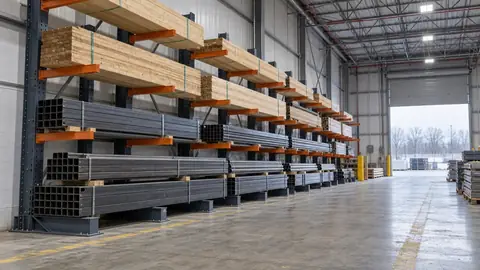
Cantilever racking exists because pallet rack cannot hold anything longer than the beam it sits on, and most operations eventually acquire something that is. A cantilever rack stores long product on arms that project from a single upright column. Nothing sits inside a bay, and nothing gets lifted over a front beam.
That makes it the structure for lumber, pipe, tube, bar stock, sheet goods, and whatever leans against a wall in your plant. If you store long material, this is the system built for it.
Three decisions follow: single sided or double sided, arm and base geometry, and capacity.
Why Long Product Defeats Pallet Rack
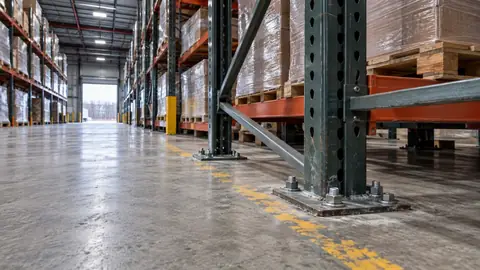
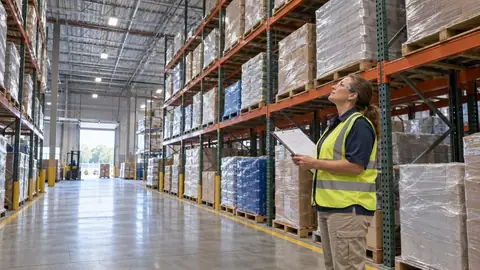
Pallet rack is a bay. Two uprights, a front beam, and a load meant to fit between them. Long material overhangs that beam, gets lifted over it, or needs a pallet nobody makes.
So it ends up on the floor. Crews bundle it, unbundle it to find one piece, then re-bundle the rest. Handling damage climbs, floor space that could hold revenue holds a pile, and stacked material can shift.
Cantilever racks offer what a pallet racking system cannot, which is open access along the full run of the load. In return, a cantilever run wants a deeper footprint per bay and usually a wider aisle.
Working through whether cantilever is the right answer for your material? Book a consultation.
Questions Operations Managers Ask About Cantilever Racks
What are the parts of a cantilever rack, and what does each one do?
Five parts, each doing one job:
- Upright column. The vertical member the arms attach to.
- Base. The horizontal foot that resists tipping force.
- Arms. The projecting members that support the load.
- Braces. Bracing that ties uprights into a continuous run.
- Arm stops. They keep round stock from rolling off.
Cantilever is freestanding because the base does the work a second upright does in pallet rack. Arms adjust at a fixed pitch, which makes the system reconfigurable later.
When does cantilever beat pallet rack or floor stacking?
The rule is short. If product length exceeds what a bay can hold, or if you need to select by size without digging, cantilever wins. If the material is palletised and uniform, it does not.
The honest middle case is medium duty stock that could go either way, and pick frequency tips it. Cantilever also handles material that cannot be banded or palletised without damage.
Single sided or double sided?
Single sided racks go against a wall and serve one aisle. Double-sided racks stand in open floor, share a column between two arm sets, and roughly double the storage per column.
Wall access, aisle count, and forklift approach decide it. A double-sided run also changes the base and bracing requirement, which belongs on an engineered layout drawing.
How do arm length and base length relate to each other?
They are linked. A loaded arm creates a tipping moment, and the base has to be long enough to resist it. Base dimension follows from arm reach and the load on it.
So a longer arm is not a free upgrade. It changes the base under it and often the aisle in front of it. The pairing comes off the manufacturer's engineered load chart.
What actually decides capacity on a cantilever system?
Four variables, none of them a single headline number. Rated capacity per arm. Arm pitch on the upright. How many cantilever arms actually sit under the load. Whether that load is distributed or concentrated at one point.
The common mistake is reading one figure off a cantilever rack system spec sheet, then applying it to a load resting on two arms. Racking systems also come in duty classes, so a medium duty rack and a heavy duty rack are not interchangeable. Anchoring and the slab go to a licensed engineer.
Should long product be stored horizontally or vertically?
Horizontal storage on arms is the default for anything heavy, anything that sags, and anything picked by length.
Vertical storage suits shorter or lighter stock where floor area is scarce and ceiling height is not, using restraint rather than arms.
For lumber and other wood products, the deciding factors are sag across an unsupported span, moisture, and pick method. Arm spacing matters more than the orientation argument.
What to Have Ready Before a Layout Conversation
A cantilever racking system stops being a catalog decision at a few specific points. When the load is concentrated rather than distributed. When the run is long enough that bracing has to be designed. And when the slab or seismic question goes to your local building official and a licensed engineer.
Come with what you already know. Lengths and weights first, then pick method. Add forklift type and reach, ceiling and sprinkler heights, building column locations, slab information, and the aisle width you can give up.
W.T. Hight Company is a consultative material handling supplier serving Massachusetts, New England, and the wider Northeast. Cantilever systems get sized to what you actually store, not to a bay count.
FAQs About Cantilever Racking
Q: Can a cantilever rack be reconfigured or extended after it is installed?
A: Usually yes. Arms adjust on the uprights at a fixed pitch, and a run often extends with added uprights and braces. Confirm any change against the engineered design first.
Q: What measurements should you take before asking for a cantilever layout?
A: Gather five things before you call. The longest and heaviest material you store, clear height to ceiling and sprinklers, and available aisle width. Then building column locations and forklift type and reach.
Get the Long Product Off the Floor
Every square foot holding a pile of long material is a square foot not holding anything that pays. Cantilever racking brings that storage back, starting with a layout rather than a bay count.
Request a quote with your dimensions in hand.