
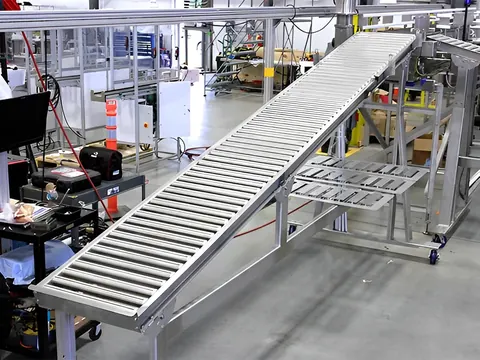
Conveyors are how a facility takes repetitive, labor-heavy trips off the floor and turns them into a continuous, controlled flow. The hard part is that “conveyor” covers a dozen very different machines, and the right one depends entirely on what you are moving and how. Pick wrong and you have an expensive line that jams, damages product, or sits idle.
This guide walks through the main types of conveyor systems, what makes up a system, and how to choose, from a supplier that has been laying out material movement for Northeast facilities since 1866.
What is in a conveyor system?
A conveyor system is more than the belt or rollers you see. A complete system typically includes:
- The conveying surface (belt, rollers, chain, slats, or wheels)
- A drive (motor and gearbox) on powered systems
- Frame and supports that set the height and path
- Controls that start, stop, meter, and sequence the flow
- Accessories: guard rails, transfers, merges, diverts, sensors, and ergonomic features
Understanding that a conveyor is a *system*, not just a surface, is what separates a line that works from a line that constantly needs babysitting.
The main types of conveyor systems
Gravity conveyors (roller and skatewheel)
The simplest and most economical type. Product moves by gravity down a slight decline or by a worker’s push on a level run. No motor, no power.
- Best for: loading docks, packing areas, simple transfers, low-to-moderate volume
- Pros: low cost, no power, easy to reconfigure
- Cons: no precise control of speed or spacing
Belt conveyors
A continuous belt over a bed or rollers, driven by a motor. The workhorse of powered conveying.
- Best for: moving items of varied size and weight, inclines/declines, irregular or small items that would fall between rollers
- Pros: handles almost anything, smooth and reliable, good for inclines
- Cons: higher cost than gravity, belt wear over time
Roller conveyors (powered / live roller)
Motor-driven rollers move product along the line, often zoned so sections start and stop to accumulate product without crushing it.
- Best for: cartons, totes, and pallets in distribution and order fulfillment
- Pros: good control, accumulation, durable
- Cons: not ideal for small or irregular items that need a solid surface
Chain and slat conveyors
Chains (or slats riding on chains) carry heavy, hot, or awkward loads that belts and rollers cannot.
- Best for: pallets, heavy unit loads, drums, automotive and industrial parts
- Pros: very high load capacity, rugged
- Cons: higher cost, more maintenance
Overhead conveyors
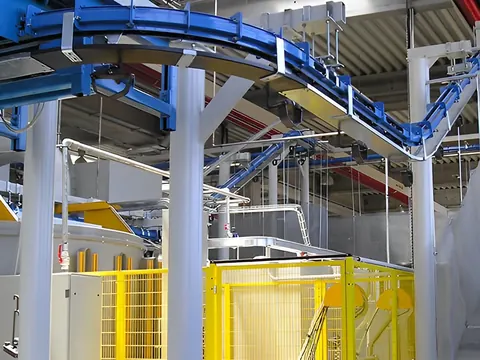
Product hangs from an overhead track, freeing the floor entirely.
- Best for: paint and finishing lines, garment handling, work-in-process where floor space is scarce
- Pros: uses unused overhead space, keeps floor clear
- Cons: specialized, fixed path
Specialty conveyors
Screw, pneumatic, vibrating, and bucket conveyors handle bulk material (powders, granules, liquids) rather than discrete units, and overlap with bulk material handling equipment.
How to choose the right conveyor system
Work through these in order:
- What are you moving? Size, weight, shape, and fragility narrow the field fast. Small or irregular items lean toward belt; pallets toward chain or heavy roller.
- How much, how fast? Low or occasional volume rarely justifies powered conveyor; gravity may be enough. High, steady throughput is where powered systems pay back.
- What path? Straight, curved, inclined, or multi-level. Inclines push you toward belt; tight floor space toward overhead.
- How much control do you need? Simple transport vs. accumulation, sortation, merging, and metering. More control means powered, zoned systems with proper controls.
- What is the environment? Heat, washdown, food-grade, or heavy industrial conditions all change the specification.
How much do conveyor systems cost?
Cost varies enormously by type and length. Simple gravity conveyor can run a low cost per linear foot, while powered, controlled, and automated systems with sortation and integration cost many times more. Because a conveyor is a system designed around your product and volume, there is no catalog price for a full line. The right way to budget is a layout and a quote based on your throughput, path, and product.
W.T. Hight designs and supplies conveyor and material movement solutions for facilities across the Northeast. Tell us what you move and how, and we will spec the right system and give you a real number. Request a quote.
Frequently asked questions
What are the main types of conveyor systems?
The main types are gravity (roller and skatewheel), belt, powered roller, chain and slat, and overhead conveyors, plus specialty bulk conveyors like screw and pneumatic. The right type depends on what you are moving, your volume, and the path.
What is in a conveyor system?
A complete conveyor system includes the conveying surface (belt, rollers, chain, or wheels), a drive motor on powered units, the frame and supports, controls, and accessories such as guard rails, transfers, merges, diverts, and sensors.
How much do conveyor systems cost?
It ranges widely. Simple gravity conveyor is low-cost per linear foot, while powered and automated systems with controls and sortation cost many times more. Pricing depends on length, type, and integration, so a layout-based quote is the only accurate way to budget.
What is the most common type of conveyor?
Belt and powered roller conveyors are the most common in warehousing and distribution because they handle a wide range of items with good control, while gravity roller conveyor is the most common simple, unpowered option.