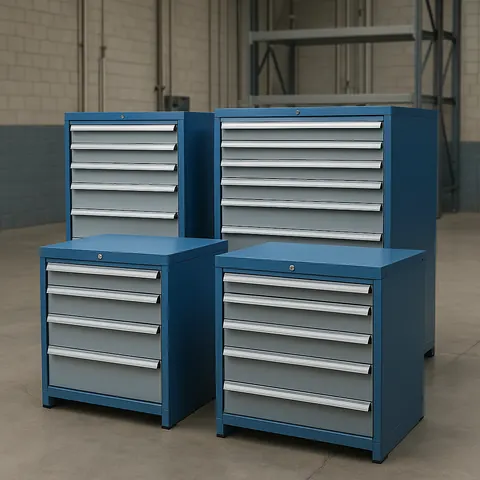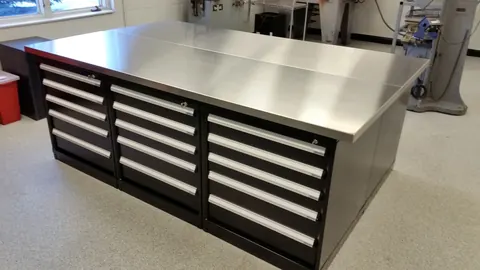
What is a modular drawer cabinet, and what does it replace?
A modular drawer cabinet earns its footprint by turning vertical space into indexed, retrievable parts storage instead of stacked shelf clutter. It is an industrial cabinet whose full-extension drawers subdivide into a configurable compartment layout. One bank can carry a large part count with every item visible the moment the drawer opens.
Modular means three things get specified rather than inherited: the drawers themselves, the layout inside each drawer, and how the cabinets bank together on the floor.
What it displaces is familiar to anyone who runs a stockroom. Open shelving that shows only the front row. Bin walls that swallow small items. And the parts that end up living on a bench, because nothing in the room has a home for them.
Why shelving loses to drawer cabinets on small parts
Density here is a visibility argument, not a percentage. A shelf shows you the front row and hides everything behind it. A drawer shows every compartment at once, which is why a parts storage cabinet beats shelving on high-count small items.
Hunting costs real money. A technician who spends four minutes finding a fitting is not turning a wrench during those four minutes. The item that cannot be found gets reordered, so shrinkage on a shelving bay is usually duplicate purchasing rather than theft.
Then there is the vertical argument. Storage cabinets stack usable space, because each drawer is filled to its own height. Shelving stacks dead air above every item on the shelf.
The honest comparison depends on your product mix and your pick frequency. That is exactly why the layout gets planned before anything is ordered.
Questions maintenance and stockroom leads ask about modular drawer cabinets
How do dividers and partitions change what fits in a drawer?
Dividers and partitions create the compartment grid, and that grid is what turns a drawer into an index. Plan the grid against the part, not against the drawer. Measure the largest item in each family first, then size its compartment to it. The same drawer gets reconfigured when the mix changes, which is the whole point of modular.
How many drawers and what heights should you plan for?
Drawer heights get chosen against the tallest item in each family. Bank them so the common picks sit at waist level and the slow movers go high or low. The available heights, and the configurations they allow, come from the manufacturer's current spec sheet. We pull those with the quote instead of estimating them for you here.
Do modular cabinets need to lock?
Lock the banks holding high-value or controlled items. Leave general consumables open, because a system nobody can get into mid-shift is a system somebody defeats with a propped drawer. A whole-cabinet lock and a per-bank lock solve different problems. Decide who is allowed at the cabinet during a shift, then pick the lock that matches that answer.
Where do these cabinets fit against existing shelving and racks?
Most stockrooms end up mixed. Bulk stays on racks, mid-size stays on shelving, and small parts move into drawers. The modular cabinet belongs on the pick path, close to the bench or counter that actually consumes the parts. Cabinets are designed to bank together, so a run can grow later without redesigning the room.
What do drawer layout kits actually give you?
Layout kits are the pre-cut divider sets that let a team create a compartment plan without fabricating anything. They matter most on day one, when the parts have to land somewhere and the plan is still settling. Confirm which kits ship with which cabinet at quote time. Do not assume a catalog photo reflects what is included.
How do you plan a layout across a whole stockroom?
Start from the pick list, not the catalog. Rank items by pick frequency, then assign them to heights and banks. Group tools and consumables separately from controlled parts, so the security plan stays simple. Measure the aisle before you commit, because a full drawer extension needs clearance that a shelving bay never asked for.
When to talk to a specifier instead of ordering from a catalog page
Four conditions say stop shopping and start specifying:
- A stockroom relocation
- A new line adding part numbers
- A bench area that has already overflowed
- An aisle that will not clear a full drawer extension
A specifier adds what a product page cannot. You get a layout plan built from your own pick list, a clearance check against your real aisles, and a shortlist of options matched to your mix. Ratings, heights and lead times come from current manufacturer data as part of that quote. They are not estimated in advance.
Working through a stockroom layout? Book a consultation for a quote or a spec review.
FAQs about modular drawer cabinets
Q: How much weight can a drawer hold?
A: Capacity is rated in lbs on the manufacturer's current spec sheet, and it varies by model, so we confirm it at quote rather than assuming it. The rating matters because it decides which drawer your heaviest part family can be assigned to.
Q: Is it easy to reconfigure later?
A: Yes. Repositioning dividers is routine work, and the space stays usable while your mix changes. Plan for it by leaving one bank unassigned through the first month.
Start with one bay and measure the result
No layout is perfect on day one. Convert one bay, count the pick time you get back and the floor you recover, then scale the solution from a number instead of a hunch. Book a consultation to request a quote or a layout review of your modular drawer cabinets.