A wire partition security cage exists to answer a question that an auditor, an insurer, or an operations director eventually asks out loud: who had access to this material, and how would you prove it? That question has four different origins, and each one produces a different specification. A facility that shops for a generic cage usually ends up with the wrong mesh, the wrong door, or an enclosure that solves a problem it did not have. Start with the reason, then specify the wire partition.
The Four Reasons Facilities Install a Wire Mesh Partition
Loss prevention. High-value or easily pocketed inventory sits behind a wire mesh partition because the enclosure is doing shrink control. The item size drives the mesh here more than anything else.
Accountability and chain of custody. The point is not a locked wall. It is a single controlled point of access that produces a record of who went in and when. This is the driver behind most tool cribs and most audited storage.
Separation and guarding. Equipment enclosures, tool cribs, and keeping personnel out of machine areas. The panel is holding people back rather than holding product in, which changes the framing and the hardware.
Regulated storage. An outside body dictates that certain material be secured and segregated, and the specification is not a preference.
Each driver changes the mesh, the framing, the hardware, and the access control you should be asking for. Two enclosures that look identical from across the aisle can be built to entirely different requirements.
Warehouse Security Cage Configurations and Where They Fit
Most warehouse security cage projects land in one of five familiar shapes.
- Tool cribs and parts cages inside a maintenance or production area, sized around a single attendant and a service window rather than a walk-in door.
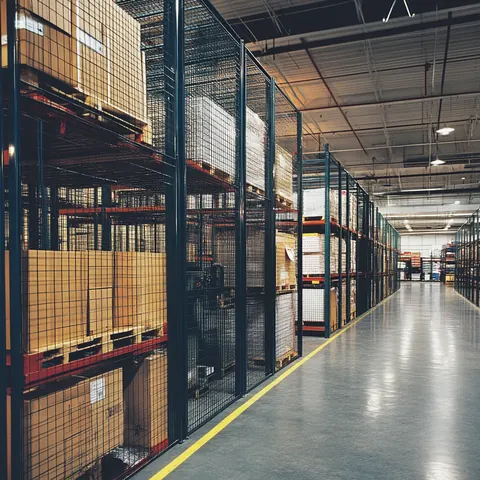
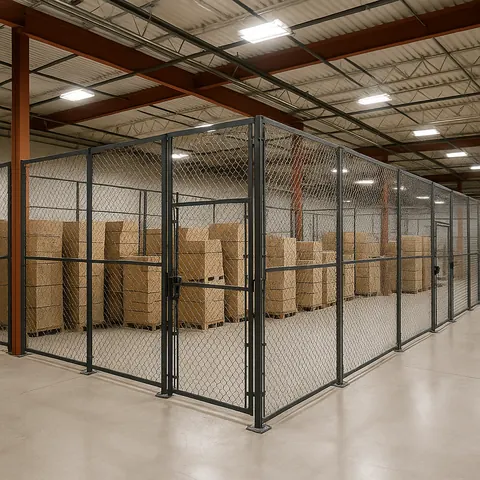
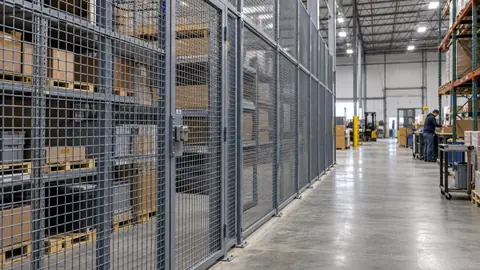
- Full-height inventory enclosures in a warehouse, typically freestanding partitions built to the deck or to a defined height with a top panel.
- Machine and equipment guarding enclosures on a plant floor, where the panel keeps people out rather than product in.
- Server, telecom, and utility enclosures inside a shared building, where multiple tenants or contractors have floor access.
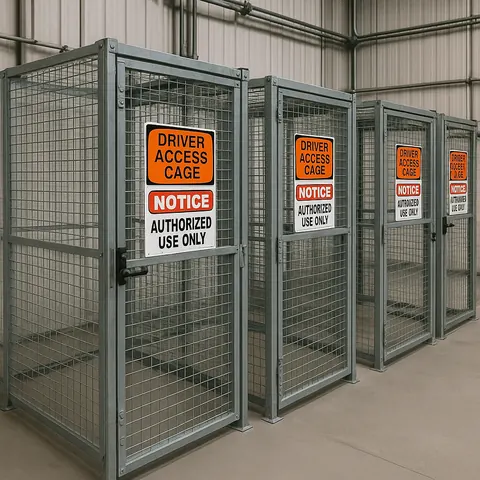
- Driver and dock cages that separate carrier access from the rest of the facility, which is a common answer once you look at who actually walks through your dock doors in a week. We wrote more about that pattern in driver access cages for high-traffic zones.
Specifying the Wire Partition Security Cage: Mesh, Framing, Doors, and Access
Mesh opening size and wire gauge get chosen against the threat and the item size. A cage sized to stop a pallet is not sized to stop a hand. Settle what you are actually keeping out before anyone quotes panels.
Panel height is the next decision. The enclosure can run to the deck, to a ceiling, or to a defined height with a top panel closing it off. What sits above the panel line matters as much as the panel itself.
Door type drives daily workflow more than anything else on the drawing. Hinged, sliding, and service or transaction windows each impose a different rhythm on the people using the space, every shift, for years.
Hardware and access control should match how the access record is expected to be produced later. A keyed cylinder and a badge reader answer the auditor's question very differently.
Panel systems are typically modular and reconfigurable, which is worth confirming in writing when you already know the layout will change.
Questions to Settle Before the Drawing
- How many people need routine access, and does that access need to be logged?
- Does the enclosure need to be relocatable, and is the building leased?
- How does material get in and out, and does that require a service window, a pallet-sized opening, or both?
Not sure which driver is actually behind your project? W.T. Hight walks the area with facility and compliance teams across Massachusetts, New England, and the Northeast US and scopes the enclosure against the real requirement, whether that is shrink, guarding, or a regulator. Book a consultation to set that up.
DEA Cage Requirements and Other Regulated Storage
A DEA cage is a controlled substance storage enclosure used by pharmacies, distributors, clinics, veterinary practices, and research operations. It looks like other wire enclosures and it is not specified like them.
The governing requirements come from federal controlled substance regulations and are enforced through inspection. That means DEA cage requirements are not a matter of preference, and they are not something a supplier gets to interpret on your behalf.
Because the applicable requirements vary by registrant type and by the schedule of material being stored, the correct sequence is to confirm the standard that applies to you with the regulator or with compliance counsel, get it in writing, and then specify the enclosure to that answer. Our overview of what a DEA cage is covers the general shape of it. W.T. Hight builds to a confirmed requirement. It does not certify compliance, and no supplier should tell you otherwise.
Insurer-driven enclosures follow the identical pattern. Get the requirement in writing first, then build the cage to it.
Where the Partition Meets the Rest of the Layout
A wire partition security cage placed without regard to travel paths quietly adds steps to every pick that touches it. Locate it against actual traffic patterns rather than the empty corner that happens to be available.
Partitions also interact with sprinkler coverage, lighting, and egress. Check those before panels are ordered, because a panel run that blocks a sprinkler head becomes a change order.
Plan the interior at the same time as the enclosure. Most cages end up holding racking, shelving, or modular drawer cabinets, and the interior storage decides how big the enclosure needs to be.
Frequently asked questions
What is the difference between a wire partition and a security cage?
Mechanically they are the same modular panel system, and a wire partition security cage is simply the version specified for controlled access. A partition divides or separates space, while a security cage controls access to what is inside it. That purpose then drives the mesh, the hardware, and the access control specified.
What are the requirements for a DEA cage?
They come from federal controlled substance regulations, are enforced through inspection, and vary by registrant type and by the schedule of material stored. Confirm the standard that applies to your operation with the regulator or your compliance counsel, then specify the enclosure to that written answer.
Can a wire partition be moved or reconfigured later?
Usually, since most panel systems are modular and bolt together. That makes them a good fit for leased buildings and for layouts you expect to change. Confirm relocatability for the specific system being quoted rather than assuming it.
Does a security cage need to go all the way to the ceiling?
It depends on the threat and on what is above the panel line. Some enclosures run to the deck, some stop at a defined height with a top panel, and some need no top at all. The decision follows from what you are protecting against, not from the height of the room.
Can wire partitions be used for machine guarding?
Yes, and guarding is one of the four main reasons facilities install them. Guarding configurations are specified differently from inventory enclosures, and the applicable requirements are enforced by regulators and by your local jurisdiction, so confirm what applies before the panels are laid out.
The right wire partition security cage starts with the reason it exists, not with a panel catalog. W.T. Hight supplies wire partitions, security cages, and DEA cages to facilities across Massachusetts, New England, and the Northeast US. Request a quote to walk the area and scope it against the actual requirement.